Acoustic Panels vs Soundproofing: What’s the Difference?
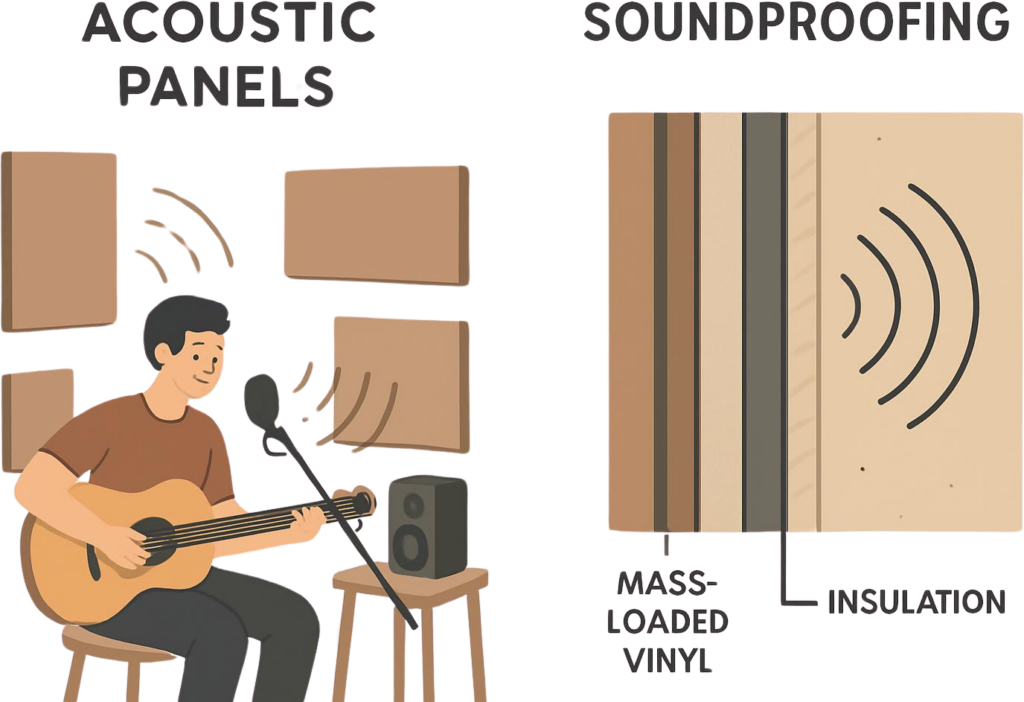
Short answer: Acoustic panels stop echo and reverb inside your room. Soundproofing stops sound from travelling in or out of your room. They solve different problems, use different materials, and cost very different amounts. Most home studio owners need acoustic panels first – soundproofing is a much bigger project.
🎯 KEY TAKEAWAYS
- Acoustic panels absorb sound – they kill echo, reverb, and slap-back. They make recordings sound cleaner.
- Soundproofing blocks sound – it requires mass, decoupling, and sealing. It stops sound leaving or entering.
- Panels are for sound quality – soundproofing is for isolation. They are not interchangeable.
- Panels cost significantly less – a full room of panels might cost a few hundred. Soundproofing a single wall often costs thousands.
- Most home studios need panels, not soundproofing – unless you share walls with angry neighbours or record at 3am.
The Core Difference in One Sentence
Acoustic panels improve how a room sounds for the people inside it. Soundproofing stops sound from bothering people outside it (or outside noise from getting in). You might want one, the other, or both – but they are completely different solutions.
What Acoustic Panels Actually Do (Absorption)
Acoustic panels are made of porous, fibrous materials – typically rigid fiberglass (like Owens Corning 703) or mineral wool (rockwool). When sound waves hit a panel, they enter the material and the fibers convert the sound energy into tiny amounts of heat. The sound does not bounce back. That means less echo, less reverb, and fewer reflections.
A standard 2-inch thick panel with an NRC rating of 0.8 to 1.0 absorbs 80–100% of sound energy that hits it in the mid-to-high frequency range (roughly 500 Hz to 4 kHz). That covers voices, guitars, snares, and most podcast/streaming audio.
What panels will not do: They will not stop sound from going through your walls to your neighbours. They will not stop traffic noise from coming in. They are for internal sound quality, not external isolation.
What Soundproofing Actually Does (Blocking)
Soundproofing (also called sound blocking or sound isolation) uses mass, decoupling, and airtight sealing to stop sound waves from travelling through building structures. Sound travels through air (voices, music) and through solid materials (footsteps, vibrating walls). Effective soundproofing addresses both.
Common soundproofing methods include:
- Adding mass – extra layers of drywall, mass-loaded vinyl (MLV), or acoustic plaster
- Decoupling – separating two sides of a wall so vibrations don’t pass through (e.g., staggered studs, resilient channels, or “room within a room”)
- Sealing gaps – caulking cracks, using acoustic sealant, adding door sweeps and double-glazed windows
Soundproofing is structural. It is built into walls, floors, and ceilings. You cannot simply “add” soundproofing to an existing room without construction – or at least significant retrofitting.
Acoustic Panels vs Soundproofing: Direct Comparison
Which One Do You Actually Need?
This depends entirely on your specific problem.
Choose acoustic panels if:
- Your recordings sound echoey, boxy, or “like a bathroom”
- You hear a metallic “boing” when you clap in your room
- Your voice sounds unclear on Zoom calls or podcast recordings
- You want to improve sound quality without construction
- You rent your home and cannot make permanent changes
Choose soundproofing if:
- Your neighbours complain about your music or drums
- You can hear traffic, barking dogs, or conversations from next door
- You record at night and need to keep sound inside your room
- You share walls with thin construction (apartments, terraced houses)
- You own your home and are willing to build/modify walls
Choose both if:
- You need isolation and good room sound (e.g., professional recording studio)
- You have the budget and permission for construction
- You want the best possible results – but expect to spend significantly more
📌 Common trap: Many home studio owners start by looking for “soundproofing” when what they actually need is echo control. If your problem is that your recordings sound bad, you need acoustic panels. If your problem is that the neighbours are angry, you need soundproofing. Do not confuse the two – you will waste time and money.
Common Myths About Acoustic Panels and Soundproofing
Myth #1: “Acoustic panels will soundproof my room”
False. This is the most common misunderstanding. Acoustic panels absorb reflections inside the room. They do almost nothing to stop sound from travelling through walls. If you can hear your neighbour’s TV through the wall, panels on your side will not help.
Myth #2: “Egg crate foam is soundproofing”
False. Egg crate foam (often sold as “acoustic foam”) is a very basic absorber for high frequencies. It is not soundproofing. It will not stop sound leaving your room. It barely helps with midrange frequencies like voices.
Myth #3: “I can soundproof a room for a few hundred”
False. Proper soundproofing is expensive. Adding mass, decoupling walls, and sealing gaps for a single wall can easily cost thousands. If a product claims cheap soundproofing, it is likely an absorber – not a blocker.
Myth #4: “Soundproofing will fix echo inside my room”
False (mostly). Soundproofing construction (like adding extra drywall) might incidentally absorb some reflections, but it is not designed for that. If your room sounds echoey, solve that with acoustic panels – it will be cheaper and more effective.
Conclusion: Your Actionable Next Step
Here is a simple decision flow to help you move forward:
- Clap test in your room. Hear a ringing echo? Start with acoustic panels.
- Ask your neighbours (or listen outside). Can they hear your music clearly? You need soundproofing.
- If your recordings sound bad but neighbours are fine → buy or build acoustic panels. Focus on first reflection points.
- If neighbours complain but your room sounds fine → research soundproofing (mass, decoupling, sealing). Be prepared for significant cost and construction.
- If you have both problems → treat the room with panels first (cheaper, faster). Then save for soundproofing if needed.
Most home studio owners, podcasters, and musicians recording in bedrooms only need acoustic panels. Soundproofing is for people with neighbour disputes, thin apartment walls, or professional studio requirements. Know which problem you are solving before you spend any money.
Not sure which you need? Start with the clap test – it takes 10 seconds and will tell you if echo is your problem.